
Online vs Extension Pinterest Video Downloader (2026 Guide)
If you search for the online vs extension Pinterest video downloader question, you will find feature tables that never answer it. The old version of this page was one of them: a checklist promising “HD, Full HD, 4K”, a batch board downloader, a format converter, subtitle extraction, and a “Pincase” extension “coming soon”. None of those were tested, and several do not exist as described. I rebuilt this guide as a decision instead of a catalogue: when the web tool wins, when an extension earns its permissions, and what neither route can do. The extension deep dive is in our extensions comparison; this page is about choosing between the two routes.
The short answer: use the online tool unless you download often on a desktop. A web tool runs in a tab, sees only the link you paste, and works on every device including your phone. An extension puts a button on the pin itself — but it lives inside your browser, needs permission to read Pinterest pages, and only runs on desktop. If you save a video or two a week, the extension’s convenience is not worth its access. If you save twenty pins a day on a desktop, it is. Everything below is the reasoning behind that line, including the permission question no competing guide answers.
How to choose: online vs extension Pinterest video downloader, step by step
Answer in order. The first “yes” that fits is your route — stop there; the rest is for heavier users.
- Are you on a phone or tablet? The choice is already made: online tool. Browser extensions do not run on mobile browsers, so the extension route is not on the table. Copy the pin link, paste it into a web tool, save the file.
- Is it someone else’s or a shared computer? Online tool. Installing an extension on a machine you do not own leaves software behind on it, and a managed work machine may not let you install one.
- Is this a one-off save, or a few pins a week? Online tool. The copy-paste round trip costs about ten seconds per pin. An extension saves most of that — but only after you install it and grant it page access.
- Do you save pins every day on a desktop, in batches, while browsing Pinterest itself? Extension — the one case where it earns its keep: the button on the pin removes tab-switching, and over dozens of pins a day that adds up.
- Do you need pins from boards only you can see? Read the permissions section below first: this is where the routes genuinely differ, and where the wrong choice either fails or over-shares.
The online route: a tab, a pasted link, nothing left behind
The online route is the simplest shape a downloader can take. You copy a pin’s link, open the downloader site in a tab, paste the link, and get a file back. Nothing is installed, no account is created, and when you close the tab, nothing of the tool remains. That reversibility is its biggest advantage: nothing to update, nothing that breaks when Pinterest changes its pages, nothing watching later sessions.

What the online route sees is exactly what you give it: one link — not your Pinterest account, boards, login session, or anything else open in your browser. That is also its hard boundary, which the old page blurred: a web tool works on public pins only, one pin at a time. It cannot reach a private or secret-board pin, because you never gave it your login — and any tool asking for your Pinterest password to “unlock” private pins is not a downloader, it is an account compromise waiting to happen. The same boundary applies to batch claims: pasting a board URL into a web tool does not download the board’s videos, whatever the old page promised.
The online route’s other honest limits: it depends on the tool’s server being up and its extractor working on the day you need it (see the failure ladder below), and it returns the quality Pinterest serves, never more. A pin uploaded in 720p comes back as 720p; no tool upgrades it to 4K.
The extension route: one click on the pin, in exchange for living in your browser
An extension removes the round trip. Once installed in a desktop browser, it adds a download button to pins while you browse Pinterest, so saving is click-and-done without leaving the page or copying links. For someone saving dozens of pins a day on a desktop, that is a genuine workflow win — the “power users” case the old page correctly identified, even while it oversold everything else around it.
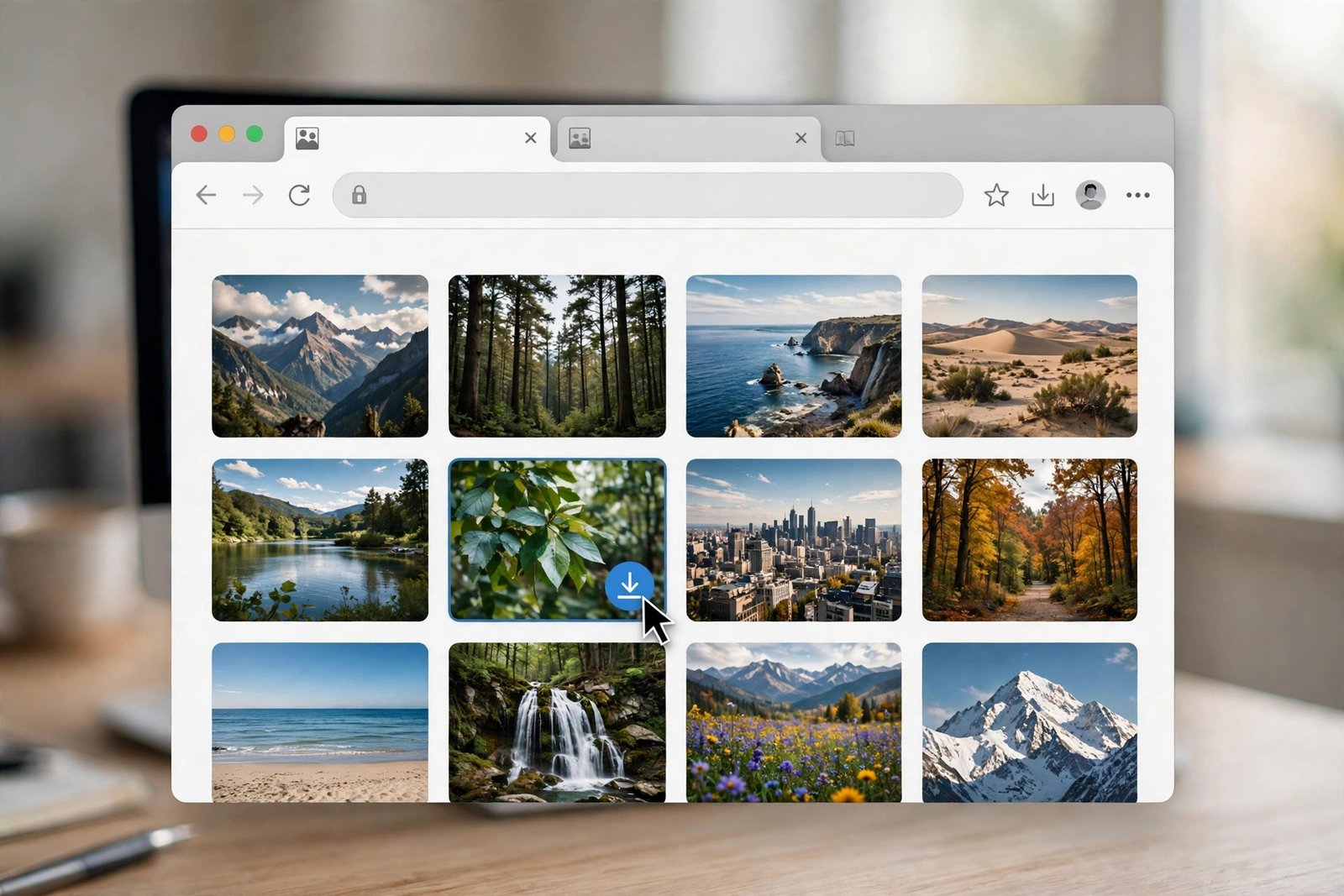
But the convenience has a price the old page never mentioned: to put a button on Pinterest pages, the extension must be able to read those pages. It runs inside your browser, on Pinterest’s site, every time you visit — a fundamentally different position from a web tool that only ever sees a link you paste. It also only exists on desktop browsers, and it can stop working overnight when Pinterest changes its page structure, leaving you to wait for the developer’s update. Individual extensions differ a lot in quality, permissions, and maintenance, which is why we compared them separately in the extensions comparison rather than re-ranking them here. Pick the route first, then the extension.
Permissions: the section every other guide skips
This is the part of the decision that actually matters, and the part no competing guide explains. “Check the permissions” is not advice; it is a shrug. Here is what the permission screen really tells you.

Two very different kinds of access. A well-scoped extension asks for access to Pinterest’s site only — it can read and change pages on pinterest.com so it can add its button there, and nowhere else. A badly scoped one asks to “read and change all your data on all websites” — your bank, your email, every other tab. That single line is the whole decision in miniature: site-scoped is a reasonable price for the convenience; all-sites access for a downloader is a no, full stop.
Session inheritance — the thing nobody warns you about. Because an extension runs inside your browser while you are logged into Pinterest, it operates with your session. That is why an extension can reach pins on boards only you can view, while a web tool cannot: the extension is, in effect, browsing as you. That capability is also the risk — a malicious or sold-off extension does not need your password to act with your login’s reach; it already has the session. That is why the developer’s identity, update history, and data-collection disclosure matter more than the star rating — and why you should remove an extension when you stop using it.
The pre-install check, in full: official store only, never a sideloaded file; read the exact permission list and reject all-sites access; read the data-collection disclosure and reject anything that sells data or tracks browsing; check the last update date and developer name — anonymous, years-stale extensions are how hijacked search and injected ads arrive; and never type your Pinterest password into a downloader, extension, or web tool. No legitimate saving tool needs it. The web tool’s version of this check is shorter: HTTPS, nothing but the link, never an install, a login, or a disabled antivirus.
What each route cannot do
| Limit | Online tool | Extension |
|---|---|---|
| Private or secret-board pins | Cannot reach them — it never sees your login | Can reach pins you can already view, via your logged-in browser |
| Batch / whole-board video downloads | No — one pin at a time | Faster pin-by-pin saving, but no one-click board video download; bulk is a desktop-software job |
| Mobile phones and tablets | Yes — any mobile browser | No — desktop browsers only |
| Quality beyond the source | Neither route can deliver more quality than Pinterest serves for that pin; “4K on every pin” is an upscale or a lie | |
| Surviving Pinterest changes | Breaks when the tool’s extractor breaks; retry or switch tools | Breaks when Pinterest changes page structure; wait for the developer’s update |
| What it can see | Only the link you paste | Every Pinterest page you visit while installed (every site, if granted all-sites access) |
| Leaving anything behind | Nothing — close the tab and it is gone | Stays installed until you remove it |
On a phone, there is no decision to make
Say it plainly: on a phone, the online-vs-extension debate does not exist. Extensions do not run in mobile browsers, so the online tool is the only route. Copy the pin link in the Pinterest app, paste it into a web tool in Safari or Chrome, and the video lands in your files. On iPhone, Safari saves it to Files under Downloads; open it there, tap Share, and choose Save Video for your camera roll. That detour is a Safari behaviour, not a downloader flaw, and any guide promising an iPhone extension is selling something else.
One more phone truth: Pinterest itself now offers a limited official download on mobile — creators can opt in to let people download their full-screen video pins, off by default, watermarked with the creator’s name. When that option exists on a pin, use it first: fastest, safest, creator credited, no third party involved. When it does not exist, that absence is itself information — the creator did not opt in, and no legitimate tool changes that.
What I tested — and what the tool did on the day
I ran this test because the online vs extension Pinterest video downloader debate is usually argued without data. I drove the live PintoDownload homepage through a clean desktop browser session, woke its deferred scripts with a genuine click first (the way the live site requires), and pasted the same public 10-second test pin sibling rewrites used earlier today. Here is what happened on 26 October 2026:
| Step | Measured result |
|---|---|
| Homepage input ready | 1.8 seconds |
| Submit 1 | No answer — hung 92.8 s |
| Submit 2 | No answer — hung 93.6 s |
| Submit 3 | No answer — hung 93.6 s |
| Links returned | 0 |
| Installs / permissions | None |
An earlier run died before any submit on a test-harness failure, so it is not counted above. The three hangs are the finding: the page loaded fine, the pin was typed and submitted correctly three times, and the tool answered nothing. That is why this article ships with no video: a failed-flow recording is not a download demo, and I will not dress one up as evidence.
Two things this failure does and does not prove. It does not prove the pin is dead: the same pin returned working links in sibling tests earlier the same day, and a same-day check of the pin’s own Pinterest file found it live (720p, 2.7 MB, 10.17 seconds). It does prove something more useful: the online route’s weakest point is not its design but its dependence on one tool working on the day you need it.
When a download fails, work this ladder
- Retry once or twice. Earlier today the same tool failed fast, then succeeded on the identical pin for a cause never proven. A single failure is not a verdict.
- Confirm the pin is still public. Open it in a logged-out window: if you cannot see it there, no downloader can retrieve it.
- Try another browser, then another tool. If the page loads but the extractor hangs or errors repeatedly, the problem is tool-side. Switching tools is legitimate; handing over your password to “fix” it is not.
- Check the official route. On mobile, look for the creator-enabled download option on the pin itself before reaching for any third-party tool.
- For extensions specifically: if a button that worked yesterday is gone today, Pinterest probably changed its page structure — check for a recent update, and if there is none, remove it.
Frequently asked questions
Online vs extension Pinterest video downloader — which is better?
Neither, in general — it depends on volume and device. Online wins for occasional saves, phones, and shared computers. An extension wins only for frequent daily desktop saving, where the button on the pin repays its permissions.
Is it safe to install a Pinterest downloader extension?
It can be, if you check the right things: official store only, reject all-sites access, read the data-collection disclosure, check the last update and developer name, and remove it when you stop using it. An extension asking for your Pinterest password is never safe.
Why did my download hang with no answer?
That is exactly what happened in my test on 26 October 2026 — three submits, each hanging over 90 seconds with no link and no error: a tool-side extractor failure, not a dead pin and not your connection. Retry once or twice, confirm the pin is still public in a logged-out window, and if it keeps hanging, try another tool.
Can an online tool download a private pin?
No. A web tool only ever sees the link you paste, so it cannot reach anything your login alone can see. An extension in your logged-in browser can reach pins you can already view — a capability and a risk, and the reason its permission screen deserves a real read.
Can I download a whole board’s videos at once?
Not with a web tool, which works one pin at a time, and not with one click from an extension either — extensions make pin-by-pin saving faster, but whole-board video downloading is desktop-software territory, for pins you can already view only. The old page promised board-URL video downloads; that promise has been removed, not repeated.
So the online vs extension Pinterest video downloader question ends where it should have started: with your situation, not a feature list. A tab you can close beats software that lives in your browser — unless you save pins all day on a desktop, in which case the button on the pin is worth paying for with site-scoped access and a developer you can name. Either way, the checks are the same: nothing asking for your password, nothing with all-sites access, nothing promising quality Pinterest never served, nothing left installed after you stop using it. For the practical side of saving today, start at the PintoDownload homepage, see the image downloader for photos, compare individual extensions in the extensions comparison, and if a download fails, work the fixes guide before blaming the pin. The gallery guide, the legality guide, and the private pins guide cover the rest. Pinterest’s own rules are the final word — see Pinterest Help and Pinterest’s Terms of Service.