
Future of Pinterest Video Downloading (2026 Guide)
The old version of this guide could not decide which year it was about. Its title said 2026, its headings said 2025, and its body kept saying 2024 — while predicting the future of Pinterest video downloading with the confidence of someone who had never checked whether an earlier prediction came true. So I rewrote it the way a trends article should be written: I read what Pinterest has actually shipped, I checked the numbers against sources dated in 2026, I tested the downloader myself with a stopwatch, and I marked every old prediction as happened, partly happened, or not happened. What is left is a shorter, dated, checkable picture — and a few trends that survive contact with evidence.
What I tested — and why a trends article needs a test at all
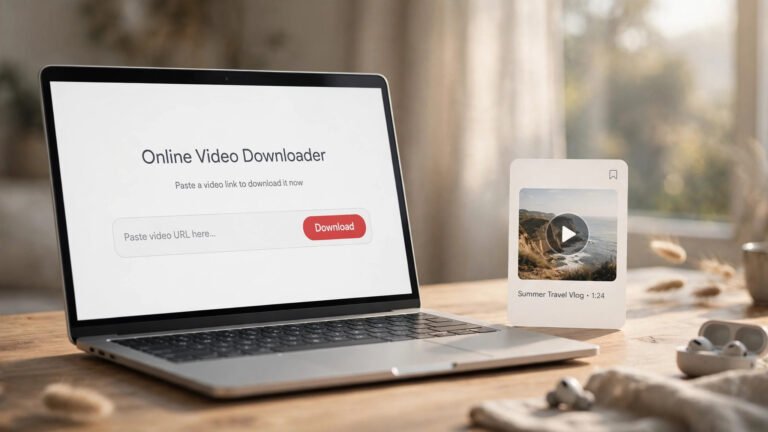
A forecast about downloading tools is worthless if the writer never ran one. I tested this site’s own tool on a public 10-second test pin, driving a real browser, with the page’s deferred scripts woken by a genuine click first (the way the live site requires). Here is what actually happened on 26 October 2026:
| Step | Measured result |
|---|---|
| Homepage input ready | 4.0 seconds |
| Submit to first MP4 link | 4.2 seconds |
| Links returned | 1 — a single 720p MP4, “Download Video” |
| File behind the link | 2.7 MB, 10.17 seconds of video (verified: HTTP 200, video/mp4) |
| Installs / permissions granted | None |
Two things in that table matter for everything below. First, the tool returned one 720p source, not a quality menu — a fact that kills half the old article’s predictions on its own. Second, nothing in the test required a login, which is exactly why the permission story in this article matters more than any feature list: the tool works on public pins, and only on public pins.
The future of Pinterest video downloading starts with what is already true
Most trends articles begin in the future. This one begins in the present, because the present already contradicts the old article. Three facts, all checked in October 2026, reframe the whole topic.
First, Pinterest is much bigger than the old trend pieces claim. Pinterest reported 640 million global monthly active users for the second quarter of 2026 (quarter ended 30 June 2026, announced 4 August 2026), up 11% year over year, with quarterly revenue of $1.18 billion. I am quoting that figure deliberately, because the competing “2026” guides I read during research still cite 454 million or 537 million users — numbers anchored in 2024 and earlier, wearing a fresh label. If a trends article cannot get the current user count right, its forecasts do not deserve your trust either. One caution: the third-quarter 2026 results were not yet out when I wrote this, so the second-quarter figure is the latest verified one — and any article quoting a newer number before that release is guessing.
Second, “Idea Pins” are not the future format — they are the retired one. The old article centres Idea Pins as the rising format. Pinterest folded the standalone Idea Pin creation format into ordinary video Pins during 2023–2024. Writing about Idea Pins as the coming thing in late 2026 is like forecasting the rise of a product that was already discontinued. The current format is the video Pin, full stop, and every trend below is stated in those terms.
Third, Pinterest already has an official download — a limited one, and that limit is the story. Creators can opt in to let people download their full-screen video Pins: the setting is off by default, applies account-wide (not per Pin), lives under Settings then Permissions (“Allow video downloads and sharing”), and works on mobile iOS and Android. Downloads arrive watermarked with the creator’s name and username, and views of shared-off-platform Pins are not tracked in the creator’s Pin Stats. I verified this against Pinterest’s own community announcement and a September 2026 guide describing the same behaviour. The implication is the trend nobody in the old article noticed: downloading’s future is increasingly permission-shaped. The more creators who leave the setting off, the smaller the share of video that any official route covers — and the more the third-party question becomes “is this pin public and available”, not “can I download anything”.
The old predictions, graded
Here is the device no competing trends page uses: revisit the predictions. The old article and its peers promised, across 2023–2025, a list of futures. Graded in late October 2026, they come out like this:
| Prediction | Verdict, October 2026 | Why |
|---|---|---|
| 4K (even 8K) downloading | Not happened | A tool can only return the file Pinterest serves. My test pin’s source was 720p, and no tool invents detail the upload never had. “4K downloading” is a claim about sources, not tool cleverness. |
| Automated / scheduled downloading of boards you follow | Not happened as a legitimate mainstream feature | Auto-saving other creators’ videos on inferred preference collides with Pinterest’s automation rules and with consent. No legitimate tool in the current landscape does this as a standard feature. |
| Voice-activated downloads (“Download this Pinterest video”) | Not happened | Announced by nobody, shipped by nobody. It was a wish dressed as a forecast. |
| Blockchain verification of downloads | Not happened | No downloader or platform uses blockchain timestamps to verify downloads in any mainstream way. It was buzzword padding. |
| Built-in offline saving from Pinterest itself | Partly happened | The limited official download above exists — opt-in, watermarked, mobile, full-screen video Pins only. That is a long way from a universal offline-save feature, and presenting the hypothetical as if nothing exists misleads readers. |
| Cross-device syncing of downloaded videos | Partly happened | Your boards sync across devices because they live on Pinterest. Downloaded files do not sync themselves — that part is still your folders, your cloud drive, your job. |
| AI auto-categorisation of downloads | Partly happened | AI recommendations and visual search genuinely shape discovery now. Automatic sorting of your downloaded files into themed folders is still mostly manual work with good folder names, not a shipped downloader feature. |
| AR video and interactive shoppable video as the near future | Not happened as mainstream Pinterest video | These have been “coming soon” since at least 2024. And an AR try-on experience cannot be saved as a flat MP4 in any meaningful sense, so AR growth, if it comes, shrinks the share of video that downloading serves rather than growing it. |
The pattern is worth naming: the predictions that failed were the ones that assumed downloading would get more powerful, more automatic, and less constrained. The ones that partly happened are the ones that respected a constraint — a permission setting, a served file, a platform boundary. That pattern is the best available guide to what comes next.
Five trends that survive contact with evidence
1. Short, instructional video keeps growing — and it is the video people most want offline
The format winning on Pinterest is the short tutorial: a recipe step, a DIY move, a styling trick, usually vertical, usually under a minute. That matters for downloading more than any other trend, because instructional video is reference video. You do not watch a fitted-sheet fold once; you rewatch it while doing it, pausing, replaying, with no buffering. The download demand here is not hoarding — it is offline reference, and it grows with the format itself. If you save one kind of Pinterest video, save the ones you will follow along with.
2. Creator control is the trend, not a footnote
Read the direction of travel: an opt-in download setting that defaults to off, watermarking that travels with the file, and a commerce push that gives creators more reason to keep viewers on Pinterest rather than watching files leave it. As more creators monetise through Pinterest’s shopping funnels, expect more of them to manage, watermark, or restrict downloads — not fewer. The practical consequence is that “can I download this?” increasingly depends on the creator’s choice, not on your tool. Check the official download option first when it exists; it is the fastest, safest route, and it carries the creator’s credit with it. When it does not exist for a pin, that absence is itself information: the creator did not opt in, and no legitimate tool changes that.
3. Quality follows the served file, and that is actually good news
The honest version of the quality trend is boring and useful: downloads get better only as fast as uploads and Pinterest’s served files do. My test pin topped out at 720p because that is what Pinterest served for it. Creators uploading higher-quality originals raise the ceiling for everyone; no tool raises it alone. So the right question to ask of any downloader is not “does it support 4K” but “does it return the source file without recompressing it or upscaling it and calling the upscale 4K”. A tool that hands you the served file, labelled honestly, is the future-proof one. A tool promising 4K on every pin is selling you an upscale or a lie, and either way it costs you megabytes.
4. AI discovery changes what people save
Visual search and AI-assisted discovery are the one AI trend with real evidence behind it: Pinterest’s own earnings commentary puts AI at the centre of its recommendation and advertising momentum. What nobody connects to downloading is what that does to saving. If discovery becomes camera-led and conversational — you photograph a chair, you ask for the look — then the saved item stops being a feed clip and becomes a found object: a product, a project, a style. That changes what a good save looks like. The file matters less; the source link, the creator’s name, and the folder it lands in matter more, because a found object you cannot trace back is useless the second time you need it. Organise by project, keep the pin title and creator name in the filename, and keep the source link with the file. The future of Pinterest video downloading is, in part, the future of the library around the download.
5. Downloads will keep breaking — plan for it
The least glamorous trend is the most certain. Pinterest changes its media delivery, recompresses uploads, changes which pins are login-only, and updates its permissions. Each change breaks some downloaders for some pins, and the breakage is usually temporary and silent: a tool that worked yesterday answers “no video found” today. I saw the honest version of this in earlier testing on this same tool — a first attempt failed fast and a retry on the identical pin succeeded, for a cause never proven. So the durable skill is not picking a tool that never breaks; it is knowing the failure routine: retry once or twice, confirm the pin is still public, check whether the creator’s download setting or the pin’s visibility changed, and never hand your Pinterest login to a tool that promises to fix it for you. A tool asking for your password is not a solution to a breakage; it is a new problem.
What to do with this
If you take one practical list from this article about the future of Pinterest video downloading, take this one. Check the official route first. On mobile, open the pin, look for the download option, and use it when the creator enabled it — watermarked, credited, no third party involved. Save the source, not just the file. Keep the pin link and creator name with every video you keep, so a saved clip stays traceable. Organise by project, not by date. A dozen videos you can find beat a thousand you cannot. Never enter your Pinterest password into a downloader. No legitimate saving tool needs it, and the ones that ask are the ones most likely to cost you the account. Private means private. Secret-board and login-only pins are not a downloading challenge; they are a boundary, and tools promising to cross it are promising to break the rules for you. And distrust any trends list that will not date its claims. If it cannot tell you when a number is from, it cannot tell you where anything is going.
Frequently asked questions
Will Pinterest add a universal download button?
There is no evidence for one. What exists is the limited official download: creator opt-in, off by default, account-wide, watermarked, mobile, full-screen video Pins only. The honest forecast is expansion or restriction of that existing feature, not the arrival of a hypothetical universal button.
Will downloaders support 4K Pinterest videos?
Only when Pinterest serves a genuine 4K file for that pin. A downloader cannot invent detail the upload never had, so any “4K on every pin” promise is an upscale, not a download.
Is automated downloading coming?
Not as a legitimate mainstream feature. Auto-saving other creators’ videos on inferred preference collides with Pinterest’s automation rules and with consent, and no legitimate tool in the current landscape offers it as a standard feature.
What happened to Idea Pins?
Pinterest folded the standalone Idea Pin creation format into ordinary video Pins during 2023–2024. If a guide still presents Idea Pins as the future format, it is working from outdated material.
How many people use Pinterest now?
Pinterest reported 640 million global monthly active users for the second quarter of 2026 (quarter ended 30 June 2026, announced 4 August 2026), up 11% year over year. That is the latest verified figure at the time of writing; third-quarter results were not yet released.
Is downloading Pinterest videos legal?
Saving a video for your own personal, offline reference is the lowest-risk use. Re-uploading, selling, or stripping creator credit is not, and downloading gives you no rights over the video. When in doubt, check Pinterest Help and Pinterest’s Terms of Service, and get the creator’s permission before republishing anything.
The through-line is unglamorous, which is why the old article never said it: the future of Pinterest video downloading will be shaped less by downloader features than by Pinterest’s own choices — what creators opt into, what files get served, and what the platform permits. Tools that respect those boundaries, return the served file honestly, and help you organise what you save will keep working. Tools that promise to outrun them will keep breaking, and occasionally take your account with them. Bet on the boring ones. For the practical side of saving videos today, start at the Pinterest video downloader homepage, and see the Pinterest image downloader, the legality guide, the fixes guide, and the low-end devices guide.